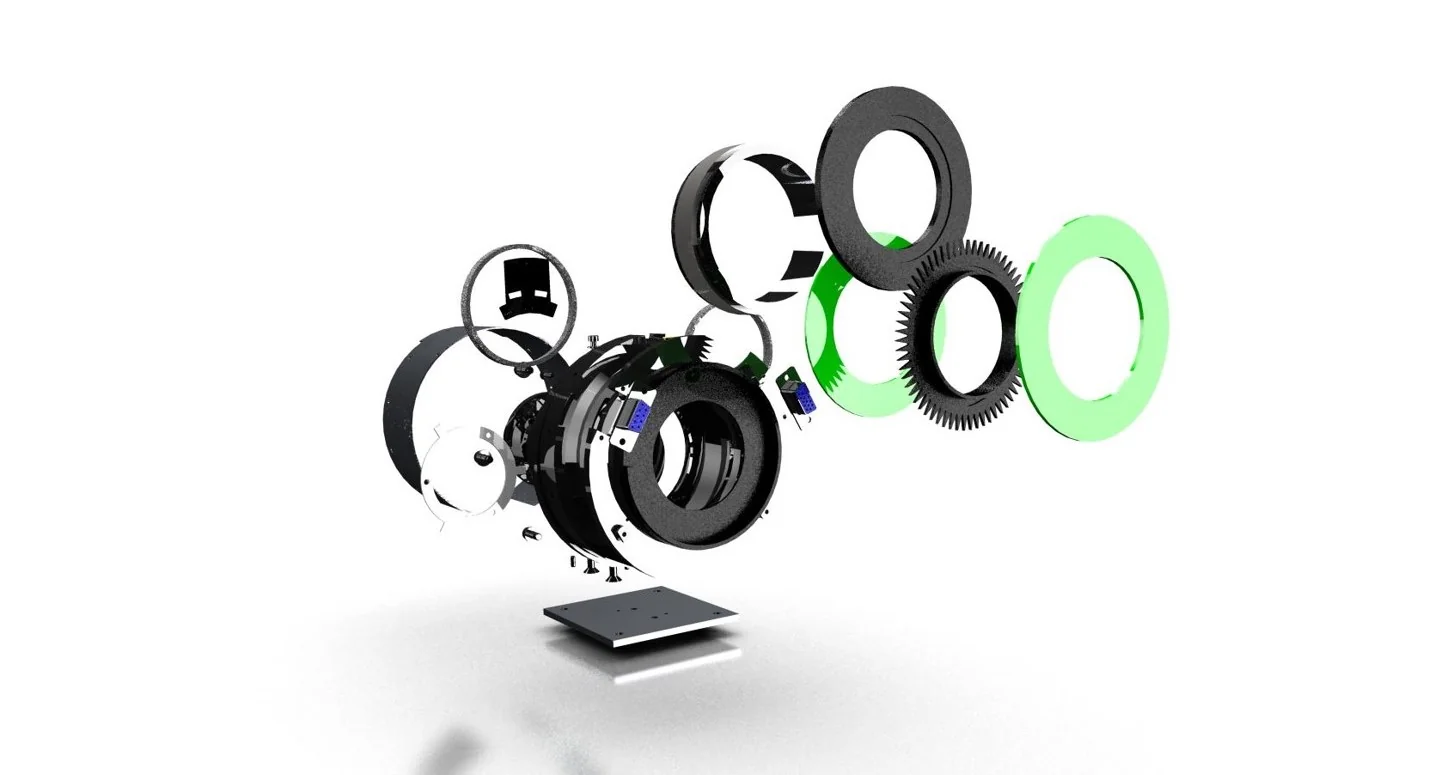
Mecanismo de Pupila RotantePupil Mask Rotator Mechanism
Prototipo de mecanismo giratorio criogénico para el instrumento HARMONI del E-ELT. Motor de eje hueco con imanes SmCo, encoder capacitivo de 19 bits y control en lazo cerrado mediante TwinCAT 3 y Beckhoff PLC.
Cryogenic rotary mechanism prototype for the HARMONI/E-ELT instrument. Hollow-shaft motor with SmCo magnets, 19-bit capacitive encoder, and closed-loop control via TwinCAT 3 and Beckhoff PLC.
CE
Cristian EstévezInvestigación · IAC · Noviembre 2016Research · IAC · November 2016
SoftwareSolidWorks / CAD
Año2016
CategoríaDiseño mecánico
ContextoIAC · E-ELT
SoftwareSolidWorks / CAD
Year2016
CategoryMech. Design
ContextIAC · E-ELT
Prototipo ensamblado del Cryogenic Pupil Mask Rotator en el laboratorio del IAC. Motor Applimotion UTS-89-A-25-A y encoder Netzer DS-90.
Los brazos del espejo secundario del E-ELT emiten radiación infrarroja que contamina las observaciones de HARMONI. El Pupil Mask Rotator mantiene una máscara térmica alineada con esos brazos en todo momento, compensando la rotación de campo del telescopio.
Selección de componentes COTS
La restricción de partida era usar componentes COTS —comerciales de bajo coste— adaptados a criogenia. Se eligió el motor de eje hueco Applimotion UTS-89-A-25-A (imanes de SmCo, más estables que el neodimio a baja temperatura) y el encoder capacitivo Netzer DS-90 (19 bits, ±36 arcsec de resolución).
Caracterización criogénica del encoder
Sin encoder de referencia criogénico disponible, se desarrolló un sistema de medición angular sin contacto basado en visión artificial: una cámara criogénica del IAC fotografía dos marcas circulares en el eje, y un algoritmo de cálculo de centroides en Python determina el ángulo con precisión mejor que 50 arcsec.
El encoder Netzer DS-90 sobrevivió a ciclos térmicos hasta 22 K y arrancó en frío desde esa temperatura sin alimentación previa. La deriva térmica entre 300 K y 25 K fue de solo 13 cuentas.
Sistema de control
El lazo de posición se cierra con TwinCAT 3 sobre PLC Beckhoff. El driver lineal de corriente —no PWM— minimiza el ruido electromagnético dentro del instrumento óptico. El error de posición obtenido fue inferior a 100 arcsec, cumpliendo la especificación de proyecto.
Fin del proyecto
Assembled Cryogenic Pupil Mask Rotator prototype at the IAC laboratory. Applimotion UTS-89-A-25-A motor and Netzer DS-90 encoder.
The E-ELT secondary mirror support spiders emit infrared radiation that contaminates HARMONI observations. The Pupil Mask Rotator keeps a thermal mask aligned with those spiders at all times, compensating for the telescope's field rotation.
COTS component selection
The starting constraint was to use COTS components adapted to cryogenic conditions. The Applimotion UTS-89-A-25-A hollow-shaft motor was chosen (SmCo magnets, more thermally stable than neodymium at low temperatures) along with the Netzer DS-90 capacitive encoder (19-bit, ±36 arcsec resolution).
Cryogenic encoder characterisation
With no cryogenic reference encoder available, a contactless angular measurement system was developed using machine vision: an IAC-built cryogenic camera photographs two circular marks on the shaft, and a centroid algorithm in Python determines the angle to better than 50 arcsec accuracy.
The Netzer DS-90 encoder survived thermal cycling down to 22 K and cold-started from that temperature without prior power. Thermal drift between 300 K and 25 K was only 13 counts.
Control system
The position loop is closed with TwinCAT 3 running on a Beckhoff PLC. A linear current driver — not PWM — minimises electromagnetic noise inside the optical instrument. The achieved position error was below 100 arcsec, meeting the project specification.