
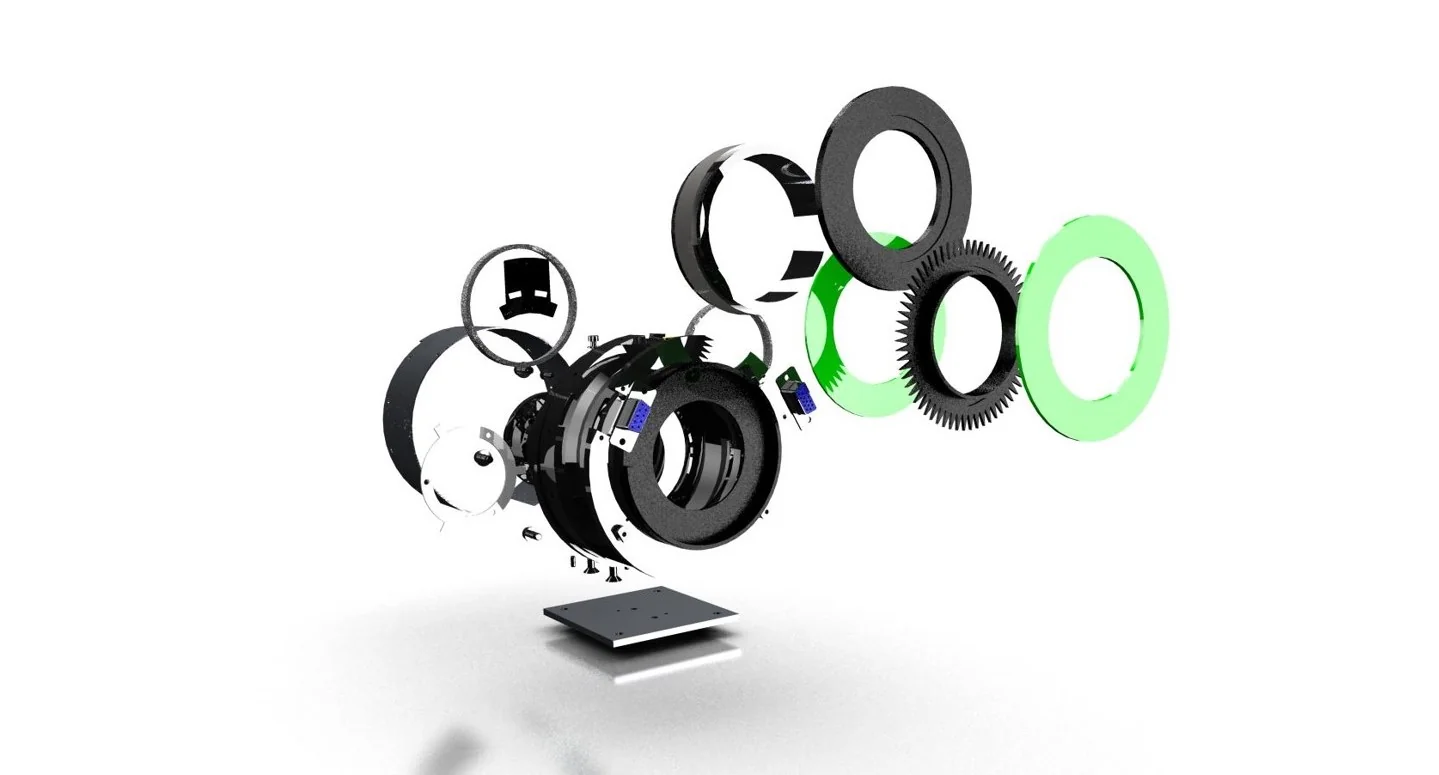
HARMONI is the first-light integral field spectrograph of the E-ELT, the world's largest optical and near-infrared telescope with a 39-metre primary mirror. The IAC is responsible for several work packages, including the Pre-Optics subsystem and control electronics. This paper documents the design and prototyping of two critical cryogenic mechanisms for that system.
The starting constraint is a project requirement: use COTS (Commercial-Off-The-Shelf) components rather than bespoke parts. The market for cryogenic components is small and expensive; standard industrial components reduce cost and schedule. The challenge is that adapting them to cryo-vacuum environments — temperatures below 80 K, pressures of 10⁻⁵ to 10⁻⁷ mbar — is technically and experimentally demanding.
Pupil Mask Rotator
The E-ELT's secondary mirror support spiders emit infrared radiation that contaminates observations. The Pupil Mask Rotator is a rotary mechanism that keeps a thermal mask aligned with those spiders at all times, tracking the telescope's field rotation.
The required motion is extremely slow — typically 15 arcsec/s — with a complex profile that depends on the declination of the observed object and accelerates near zenith. The solution was a direct-drive hollow-shaft motor (Applimotion UTS-89-A-25-A, with SmCo magnets more thermally stable than neodymium at low temperatures) combined with a 19-bit absolute capacitive encoder (Netzer DS-90, ±36 arcsec resolution).
Cryogenic encoder characterisation required creative solutions: the Heidenhain RCN-5380 reference encoder does not operate at low temperature, so an alternative contactless angular measurement system was developed using machine vision. An IAC-built cryogenic camera photographs two circular marks of different diameters on the shaft; centroid computation in Python + TwinCAT on a Beckhoff PLC yields the angle to better than 50 arcsec accuracy.
The position control loop achieves errors below 100 arcsec — better than the ±100 arcsec specification — using a linear current driver (not PWM) designed specifically to minimise electromagnetic noise inside the optical instrument.
Cryogenic Fast Shutter
The cryogenic shutter controls the detector exposure time. The specification requires 30 mm of travel in under 20 ms. After evaluating solenoids, rotary shutters and voice coils, a commercial hard drive actuator arm (Seagate ST340014A) was selected: extremely cheap, highly optimised by the computer industry, and — in its metal-coil version — with excellent thermal dissipation.
The cryogenic test campaign revealed a critical failure in plastic-structure models: vacuum prevents coil heat dissipation and the wire melts. The solution was to restrict use to metal-structure models and add over-temperature protection derived from indirect coil resistance measurement.
Room-temperature speed tests recorded at 1,200 fps and analysed in Matlab showed that bounce at the mechanical stops extends travel time beyond the required 20 ms. The identified solution: closed-loop current control to damp the motion before impact.
Conclusions
The paper demonstrates that industrial COTS components can be successfully adapted to cryo-vacuum environments, although experimental characterisation is essential in each case. For the Pupil Mask Rotator, the control algorithms were fully defined and validated; for the Fast Shutter, cryogenic survival was proven and the next step was closed-loop control.
Both developments directly contribute to reducing the cost and manufacturing schedule of HARMONI, one of three first-light instruments for the E-ELT, which will begin scientific observations in the mid-2020s.