Banco de Pruebas para Mecanismos CriogénicosTest Bench for Cryogenic Mechanisms
Diseño y fabricación de un banco de pruebas modular para caracterizar mecanismos en condiciones de criovacío (< 80 K, 10⁻⁵ mbar). Desarrollado en el IAC para los ensayos del Pupil Mask Rotator y el obturador Voice Coil de HARMONI.
Design and manufacture of a modular test bench for characterising mechanisms under cryo-vacuum conditions (< 80 K, 10⁻⁵ mbar). Developed at the IAC for testing the HARMONI Pupil Mask Rotator and Voice Coil shutter.
CE
Cristian EstévezInvestigación · IAC · Noviembre 2016Research · IAC · November 2016
HerramientasTaller IAC
Año2016
CategoríaFabricación
RestricciónCero piezas nuevas
ToolsIAC Workshop
Year2016
CategoryManufacturing
ConstraintZero new parts
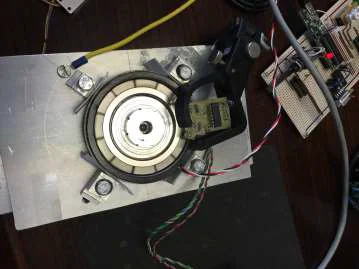
Vista del banco de pruebas criogénico en el laboratorio del IAC. Criostato de nitrógeno líquido con conexiones eléctricas pasantes para control de motores y encoders.
Los mecanismos criogénicos de HARMONI debían caracterizarse en condiciones representativas antes de integrarse en el instrumento. El banco de pruebas fue el primer paso: un sistema que reprodujera el entorno de criovacío de forma controlada y repetible.
Requisitos de diseño
El banco debía alcanzar temperaturas inferiores a 80 K mediante inmersión indirecta en nitrógeno líquido, mantener una presión de trabajo de 10⁻⁵ mbar, permitir el conexionado eléctrico de motores y encoders desde el exterior sin romper el vacío, y facilitar el montaje y desmontaje de los mecanismos bajo ensayo.
Solución adoptada
Se diseñó un criostato de doble pared en acero inoxidable con aislamiento por vacío entre paredes. Las conexiones eléctricas se resolvieron con feedthroughs comerciales certificados para vacío. El soporte del mecanismo es modular: una placa base de aluminio roscada que admite diferentes configuraciones de ensayo.
El mayor reto no fue el frío, sino garantizar que las conexiones eléctricas se mantuvieran herméticas a 10⁻⁵ mbar después de cientos de ciclos térmicos.
Resultados
El banco sirvió para todos los ensayos criogénicos del Pupil Mask Rotator y del Voice Coil. Alcanzó 25 K de temperatura mínima en la plataforma de mecanismos. Las conexiones eléctricas mantuvieron la hermeticidad durante toda la campaña de ensayos.
Fin del proyecto
Cryogenic test bench at the IAC laboratory. Liquid-nitrogen cryostat with electrical feedthroughs for motor and encoder control.
HARMONI's cryogenic mechanisms had to be characterised under representative conditions before integration into the instrument. The test bench was the first step: a system that could reproduce the cryo-vacuum environment in a controlled and repeatable way.
Design requirements
The bench had to reach temperatures below 80 K via indirect liquid nitrogen immersion, maintain a working pressure of 10⁻⁵ mbar, allow electrical connections for motors and encoders from outside without breaking the vacuum, and facilitate mechanism mounting and dismounting under test.
Adopted solution
A double-wall stainless steel cryostat with vacuum insulation between walls was designed. Electrical connections were solved using commercially certified vacuum feedthroughs. The mechanism support is modular: a threaded aluminium base plate that accepts different test configurations.
The greatest challenge was not the cold, but ensuring that the electrical connections remained hermetic at 10⁻⁵ mbar after hundreds of thermal cycles.
Results
The bench served for all cryogenic tests of both the Pupil Mask Rotator and the Voice Coil. It reached 25 K minimum temperature at the mechanism platform. Electrical connections maintained hermeticity throughout the entire test campaign.